

Executive Brief
Overview
The AI/ML lifecycle represents a framework encompassing all phases from initial problem identification through model retirement, with integrated governance and ethical considerations ensuring responsible development and deployment. Organizations implementing AI/ML systems must understand this end-to-end process to minimize risks, ensure compliance, and deliver sustainable business value.
Key Lifecycle Phases
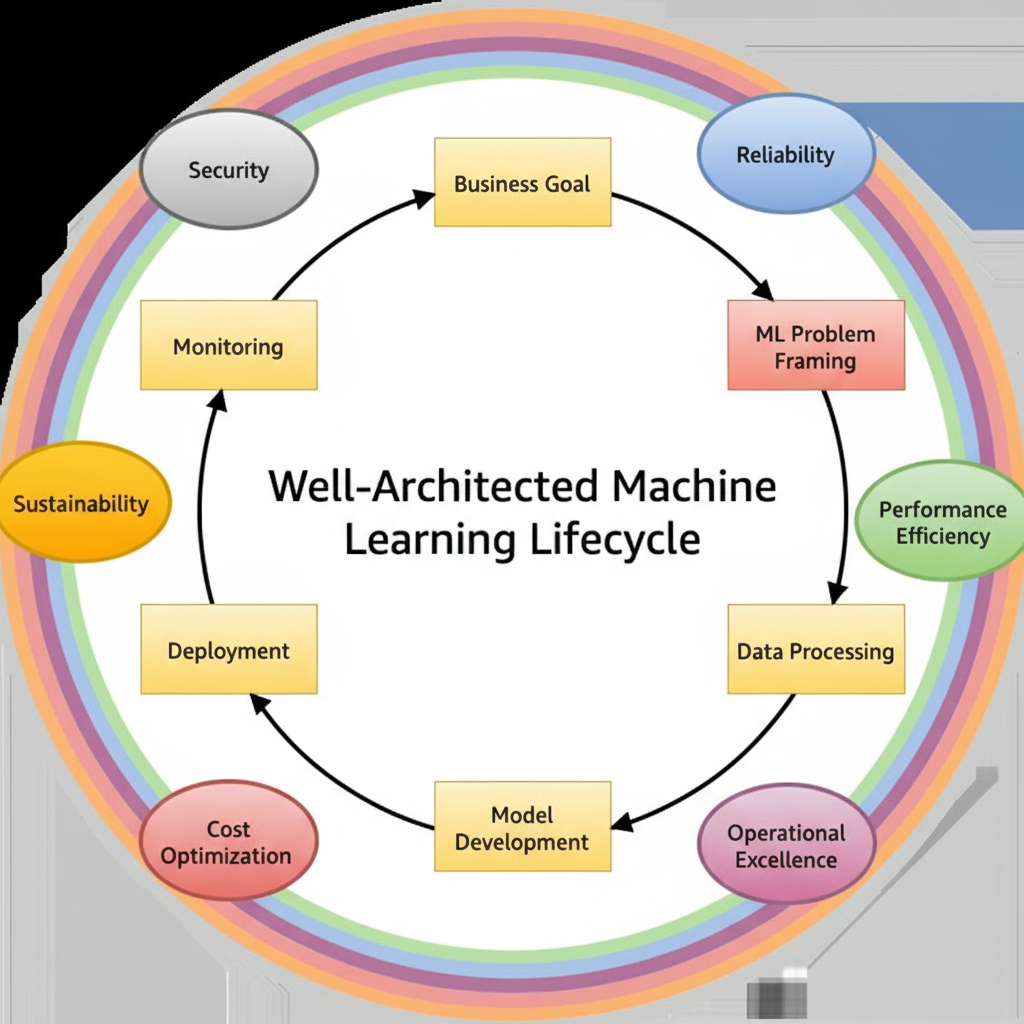
Problem Definition and Business Alignment
The lifecycle begins with clearly defining business objectives and translating them into machine learning problems. This foundational phase establishes success criteria, feasibility assessments, and stakeholder requirements that guide the entire project trajectory.^4^6
Data Processing and Management
Data acquisition, preprocessing, and feature engineering constitute critical phases requiring robust governance. Organizations must implement comprehensive data governance practices covering quality, integrity, security, and compliance with privacy regulations throughout the data lifecycle.^7^4
Model Development and Training
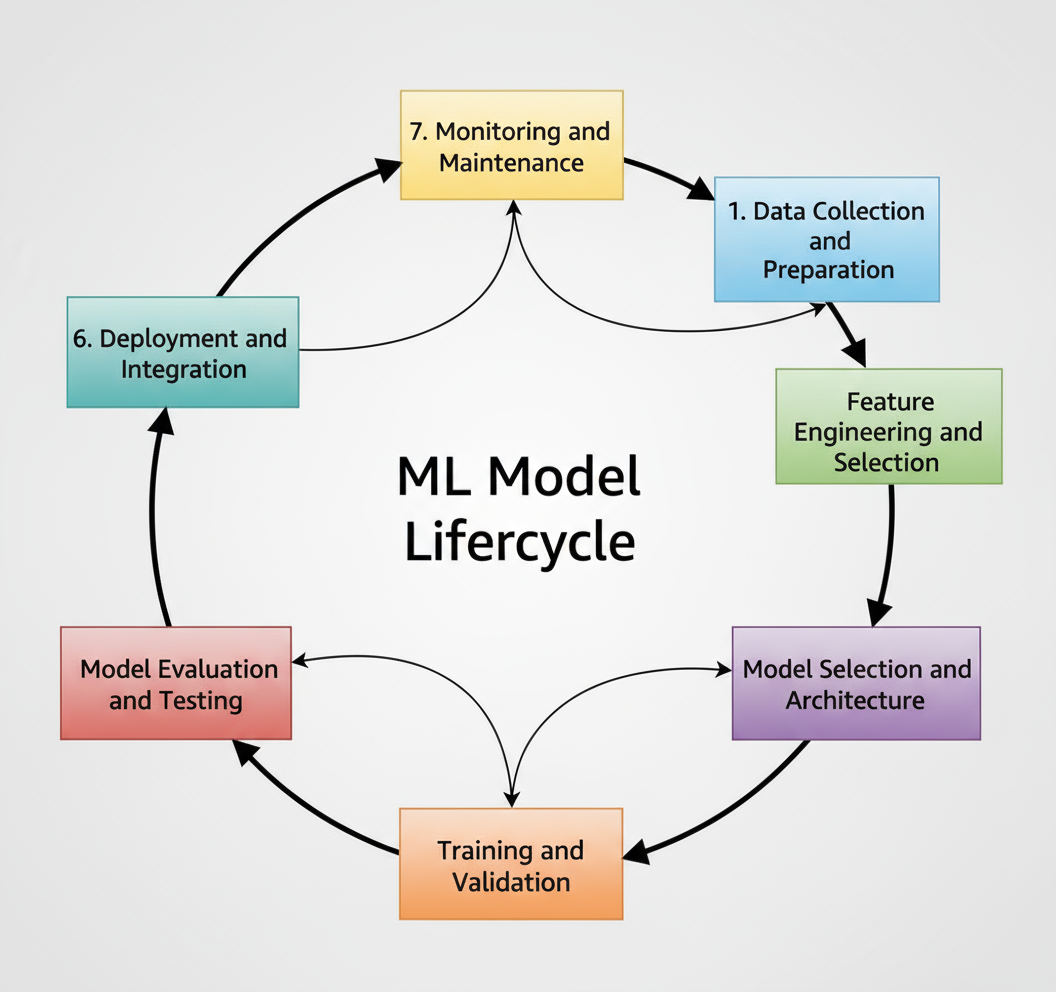
This iterative phase involves model architecture selection, training, hyperparameter tuning, and validation. Development teams must integrate ethical considerations and bias detection mechanisms from the outset, rather than treating them as post-development additions.^9^10^4
Model Evaluation and Testing
Comprehensive evaluation encompasses performance metrics, fairness assessments, explainability testing, and adversarial robustness validation. Organizations should implement multiple evaluation approaches including shadow deployments for production readiness assessment.^10^9
Deployment and Integration
Production deployment requires careful orchestration of infrastructure, API integration, version control, and CI/CD pipeline management. Security considerations become paramount, including protection against adversarial attacks, model theft, and API exploitation.^12^9
Monitoring and Maintenance
Post-deployment governance involves continuous performance monitoring, data drift detection, model retraining, and lifecycle management. Organizations must establish automated monitoring systems with defined thresholds and escalation procedures for performance degradation.^13^4
Governance Framework Components
Model Governance Structure
Effective governance encompasses recording, auditing, validation, approval, and monitoring of models throughout their lifecycle. This includes establishing model registries for version control, implementing approval workflows, and maintaining comprehensive documentation for regulatory compliance.^15^9
Cross-Functional Oversight
Successful governance requires multi-disciplinary teams including data science, legal, compliance, security, and business stakeholders. Organizations should establish ethics committees with clear escalation paths for complex ethical decisions.^16^18
Risk Management and Controls
Governance frameworks must address multiple risk categories including business, financial, legal, security, data protection, reputational, and ethical risks. Implementation requires systematic risk assessment, mitigation strategies, and continuous monitoring capabilities.^20^14
Ethical Considerations
Core Ethical Principles
Organizations must integrate five fundamental ethical principles:
Fairness and non-discrimination
Transparency and explainability
Accountability and responsibility
Privacy and data protection
Human oversight and control.
These principles should guide decision-making throughout the lifecycle rather than being applied retrospectively.^3^8
Bias Mitigation and Fairness
Addressing algorithmic bias requires proactive measures including diverse training data, fairness metrics evaluation, and continuous monitoring for discriminatory outcomes. Organizations should implement bias detection tools and establish processes for remediation when issues are identified.^2^10
Transparency and Explainability
AI systems must provide meaningful explanations for their decisions, particularly in high-stakes applications. This requires implementing explainability techniques and maintaining clear audit trails for regulatory compliance and stakeholder trust.^8^3
Implementation Best Practices
Governance Integration
Organizations should embed governance checkpoints throughout the MLOps lifecycle, including development gates, training validation, deployment approval, and monitoring alerts. Automation of governance checks ensures scalability while maintaining oversight quality.^18
Documentation and Audit Trails
Comprehensive documentation including model cards, data lineage, decision logs, and performance metrics enables regulatory compliance and supports incident investigation. Centralized documentation systems ensure accessibility for auditing and governance teams.^14^9
Continuous Improvement
The lifecycle requires iterative refinement based on production feedback, changing regulations, and evolving ethical standards. Organizations must establish processes for incorporating lessons learned and adapting governance frameworks to emerging challenges.^6^13
Strategic Recommendations
Organizations should prioritize establishing comprehensive governance frameworks early in their AI/ML journey, ensuring alignment between technical capabilities and ethical responsibilities. Success requires executive leadership commitment, cross-functional collaboration, and investment in both technical infrastructure and governance processes. The integration of ethical considerations throughout the lifecycle, rather than as an afterthought, represents a critical success factor for sustainable AI implementation.
The AI/ML lifecycle with integrated governance and ethical considerations provides organizations with a structured approach to realizing AI benefits while managing risks and maintaining stakeholder trust. This comprehensive framework enables responsible innovation that aligns with business objectives and societal values. ^22^24^26^28^30^32^34^36^38^40^42
About the author
I'm technologist in love with almost all things tech from my daily job in the Cloud to my Master's in Cybersecurity and the journey all along.


