

INTRODUCTION: THE ART AND SCIENCE OF AI COMMUNICATION
Welcome to the exciting world of Prompt Engineering! Whether you are a developer, a writer, a business leader, or simply an AI enthusiast, mastering the art of communication with artificial intelligence is one of the most critical skills of the 21st century. This series will guide you from the fundamental principles to advanced techniques, transforming you into a skilled prompt engineer.
What is Prompt Engineering?
Prompt Engineering is the art and science of designing and crafting effective inputs (prompts) to guide Large Language Models (LLMs) and other AI systems toward generating desired, accurate, and relevant outputs.
Think of it as being a skilled translator, a diplomat, or a director for an AI. You are not just asking a question; you are providing carefully constructed instructions, context, and constraints to steer the AI's powerful capabilities in the right direction. A well-crafted prompt is the bridge between human intent and machine execution.
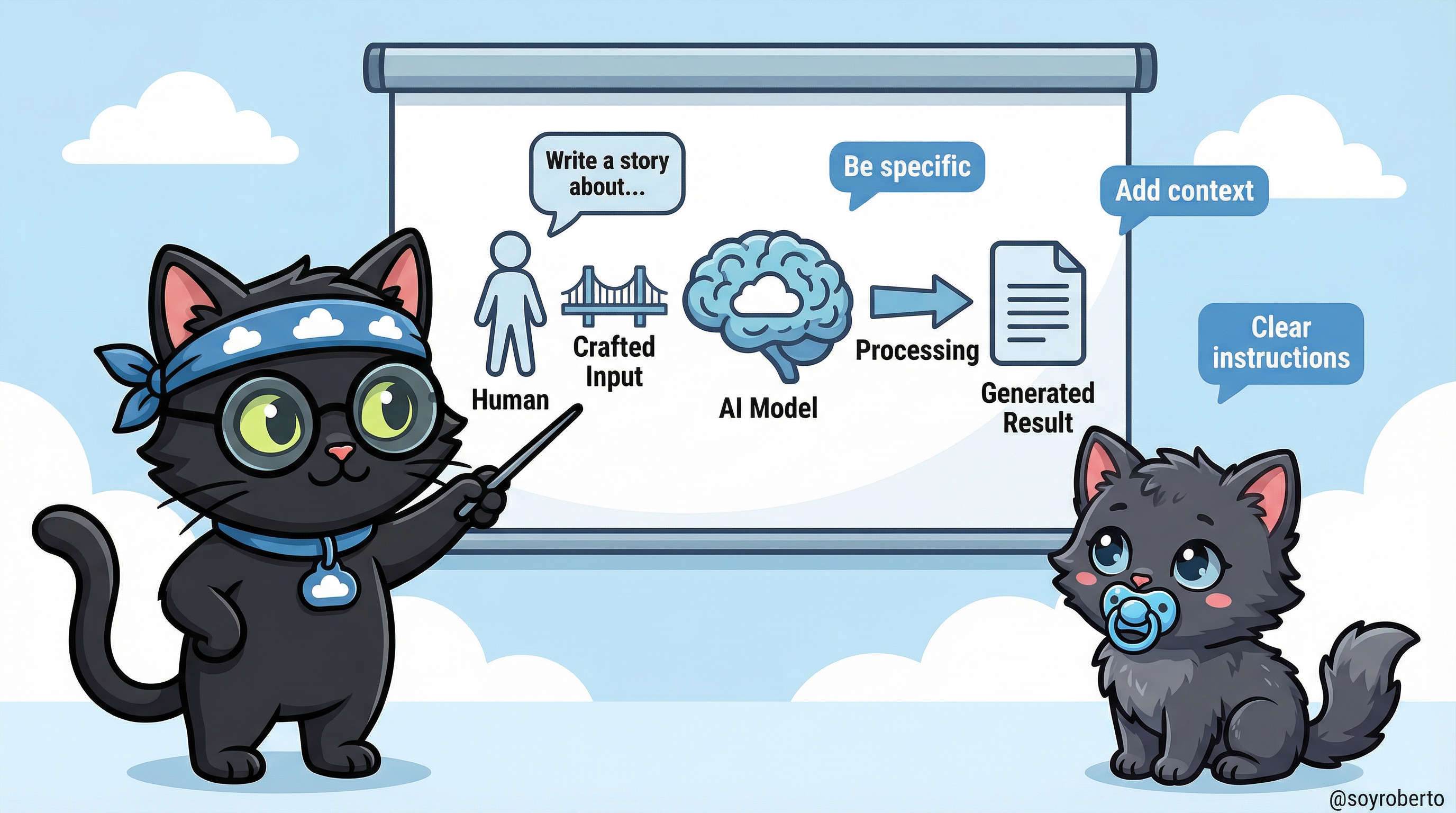
As our graphic illustrates, the process involves a human crafting a specific input, which the AI model processes to produce a generated result. The quality of that result is directly proportional to the quality of the prompt. A vague prompt leads to a vague output, while a precise prompt unlocks the AI's full potential.
Basic Principles and Concepts
Effective prompt engineering is built on a foundation of core principles. Understanding these fundamentals is the first step toward mastering AI communication.
Fundamentals of Prompt Design
At its heart, a good prompt is a clear set of instructions. Just as you would give clear directions to a person, you must be explicit with an AI. Let's break down the core fundamentals.
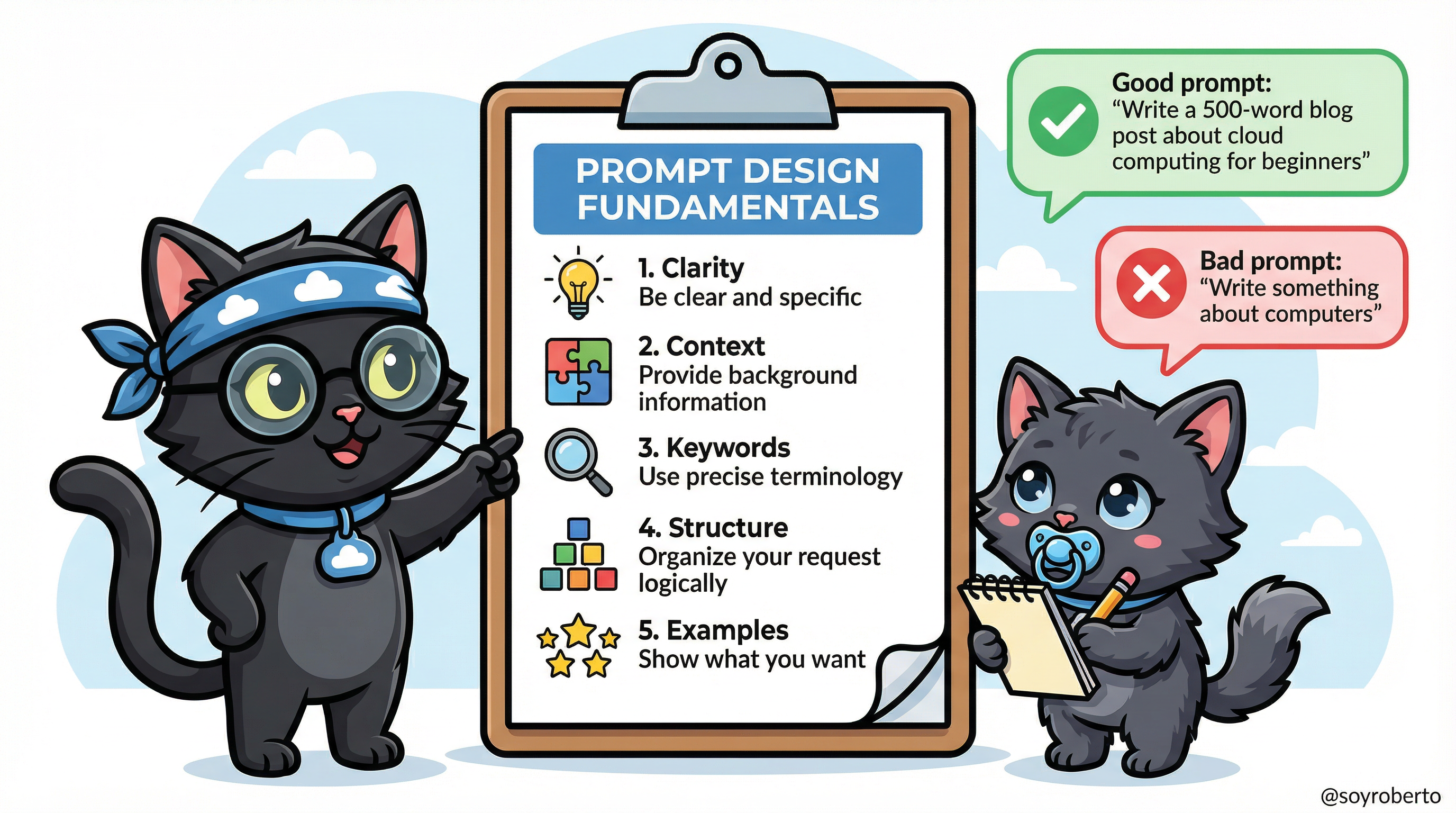
As Trufa explains to Paula, there are several key pillars to effective prompt design:
- Clarity and Specificity: Be direct and unambiguous. Instead of "Write about cars," a better prompt is "Write a 500-word article comparing the fuel efficiency of 2023 model year electric sedans and gasoline-powered sedans."
- Context Setting: Provide the necessary background information. An AI doesn't know your project's goals or your personal preferences unless you tell it. Context helps the model narrow its focus and deliver a more relevant response.
- Using Keywords Effectively: Keywords act as powerful triggers for the AI. Words like "summarize," "analyze," "compare," "translate," or "in the style of" guide the model to perform a specific task. For example, starting a prompt with "Act as a senior marketing consultant..." sets a persona for the AI to adopt.
- Structure: Organize your prompt logically. Use headings, bullet points, or numbered lists to break down complex requests. A well-structured prompt is easier for the AI to parse and follow.
- Provide Examples (Few-Shot Prompting): Show the AI what you want. If you need a response in a specific format, provide one or two examples within your prompt. This technique, known as few-shot prompting, is incredibly effective for guiding the model's output style and structure.
Prompt Engineering for Different Applications
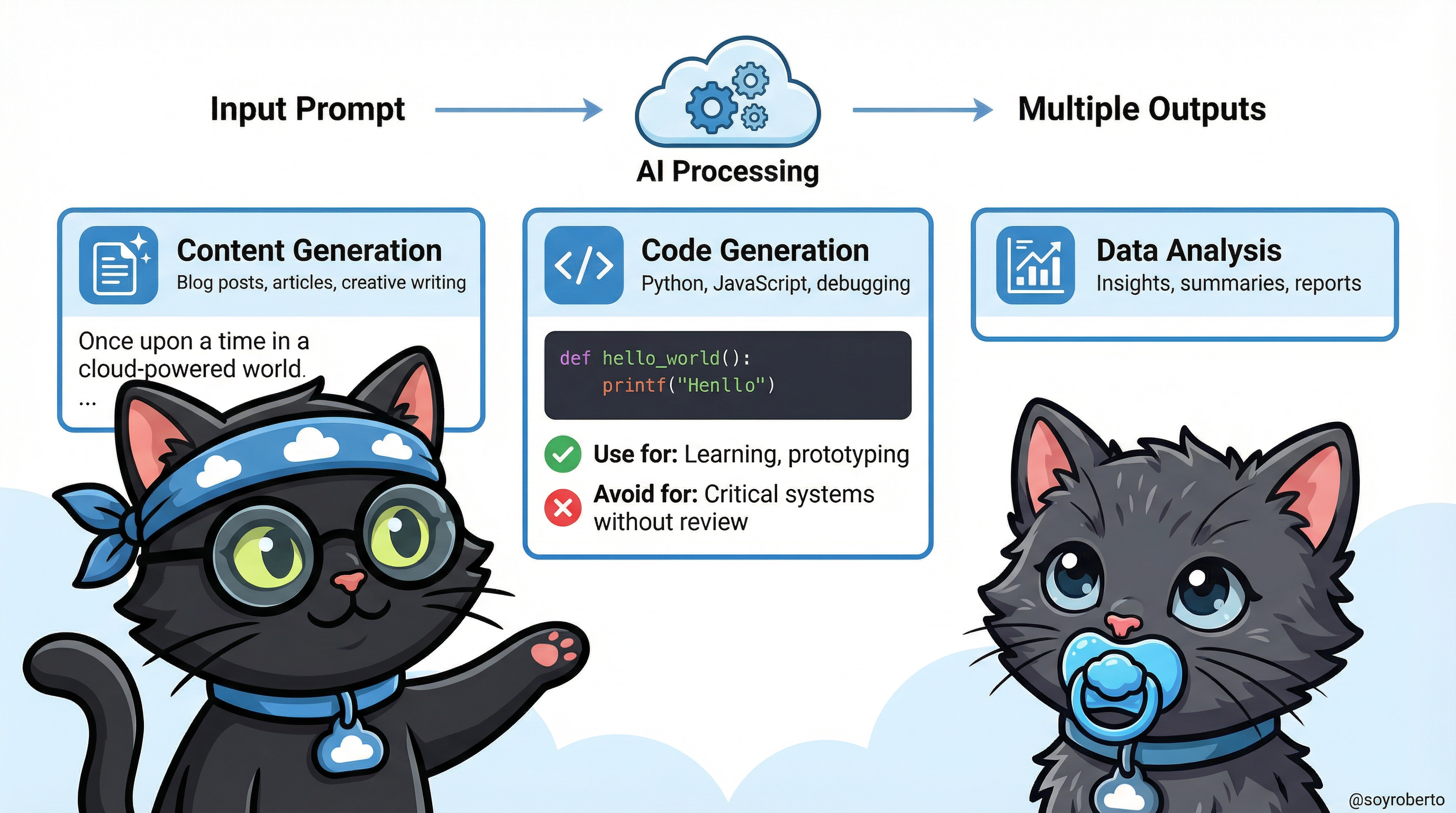
Prompt engineering is not a one-size-fits-all discipline. The techniques you use will vary depending on the application. Let's explore two of the most common use cases: content generation and code generation.
Content Generation
This is perhaps the most popular application of LLMs. From writing blog posts and marketing copy to drafting emails and creating fictional stories, prompt engineering is key to generating high-quality content.
Brief Sample:
Prompt: "Write a short, exciting paragraph for a travel blog about visiting the Swiss Alps for the first time. Use vivid language and focus on the feeling of awe."
Potential AI Output: "The moment you step into the heart of the Swiss Alps, the world falls away. Jagged, snow-capped peaks pierce a sky of impossible blue, while emerald valleys cradle crystal-clear lakes that mirror the grandeur above. The air itself feels different here—crisp, clean, and filled with the faint, melodic chime of distant cowbells. It is a profound sense of awe, a feeling of being both infinitesimally small and infinitely connected to the raw, majestic power of nature."
Code Generation
LLMs can be powerful assistants for programmers, capable of writing functions, debugging code, and even explaining complex algorithms. However, this power comes with significant responsibility.
Why it's useful:
- Learning and Education: A great tool for understanding new programming concepts or languages.
- Prototyping: Quickly generate boilerplate code or simple functions to test an idea.
- Debugging: Paste a block of code and ask the AI to find potential errors or suggest improvements.
When it should NOT be used (without caution):
- Critical Production Systems: Never deploy AI-generated code directly into a live, critical system without a thorough review by an experienced human developer. AI can make subtle mistakes, introduce security vulnerabilities, or write inefficient code.
- Complex, Novel Algorithms: While LLMs can replicate known algorithms, they are not reliable for inventing new, complex, or highly optimized ones. The risk of logical flaws is high.
The Golden Rule of AI Code Generation: Trust, but verify. Always treat AI-generated code as a suggestion from a junior developer—a helpful starting point that requires rigorous testing and validation.
Ethical Considerations in Prompt Engineering
With great power comes great responsibility. As a prompt engineer, you are in a position to influence the output of AI systems, which makes it essential to consider the ethical implications of your work.
Bias and Fairness
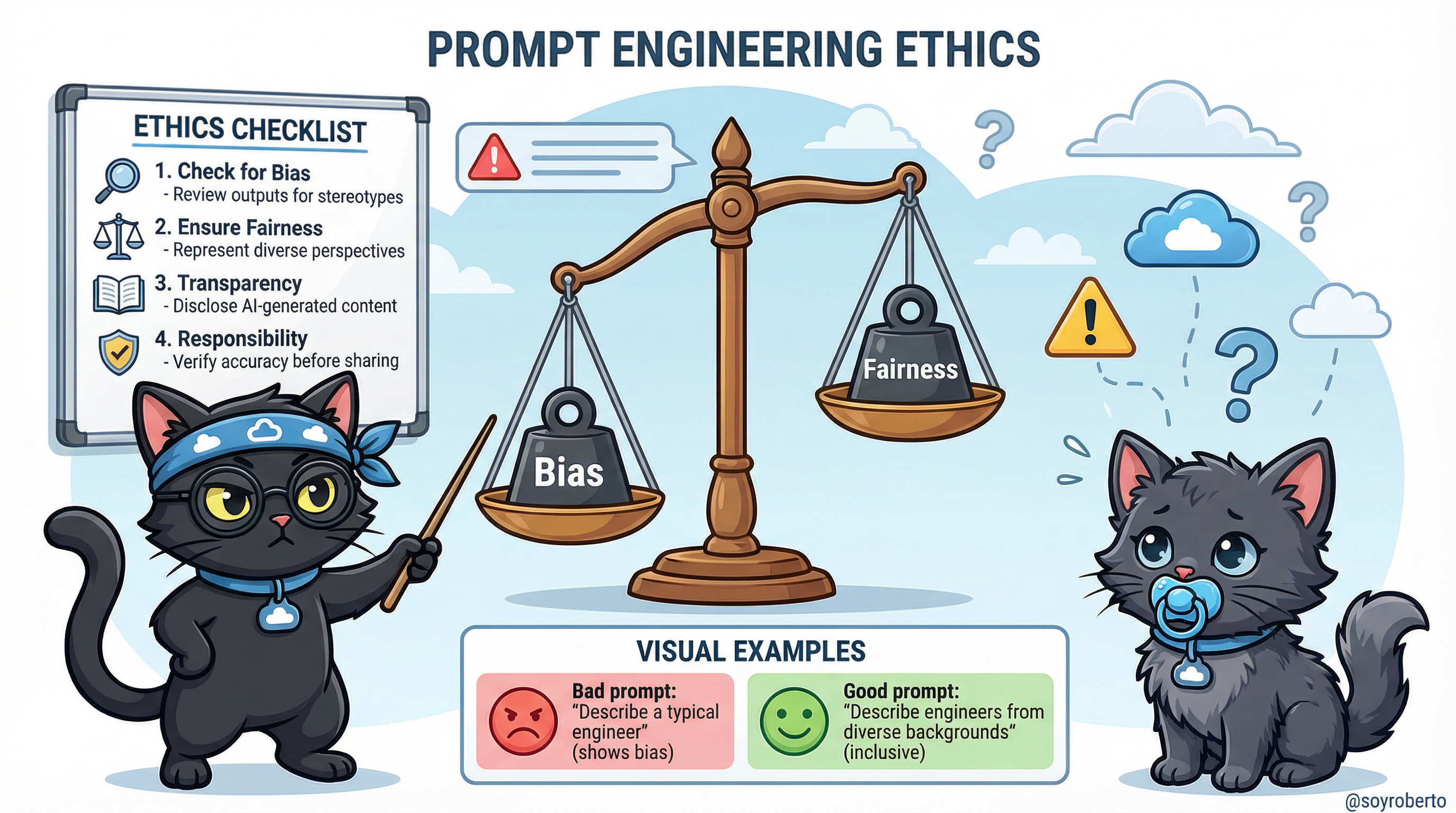
LLMs are trained on vast amounts of text and data from the internet, which unfortunately contains human biases and stereotypes. A poorly crafted prompt can easily trigger and amplify these biases.
- The Problem: If you ask an AI to "Describe a typical CEO," it might generate a description that reflects historical gender or racial biases present in its training data.
- The Solution: As a prompt engineer, you must actively work to counteract this. A better prompt would be, "Describe the qualities of successful CEOs from a variety of backgrounds, genders, and industries."
Key Ethical Responsibilities for Prompt Engineers:
- Check for Bias: Always review AI-generated content for harmful stereotypes or unfair representations. Be prepared to refine your prompt to guide the model toward a more equitable output.
- Ensure Fairness: Strive to create prompts that encourage the AI to consider diverse perspectives and avoid generalizations.
- Promote Transparency: When using AI-generated content in a public or professional context, it is often best practice to disclose that AI was used in its creation.
- Take Responsibility: You are ultimately responsible for the content you create using AI. Fact-check all information and ensure the final output is accurate, fair, and safe before sharing it.
This introduction has laid the groundwork for your journey into prompt engineering. You now understand what it is, the fundamental principles of design, its diverse applications, and the critical ethical considerations involved.
In the chapters to come, we will dive deeper into each of these areas, equipping you with the advanced techniques and practical knowledge to become a true master of AI communication.
By Roberto | @soyroberto
For more content, visit allthingscloud.net
About the author
I'm technologist in love with almost all things tech from my daily job in the Cloud to my Master's in Cybersecurity and the journey all along.
Comments
Join the discussionNo comments yet. Be the first to comment.


